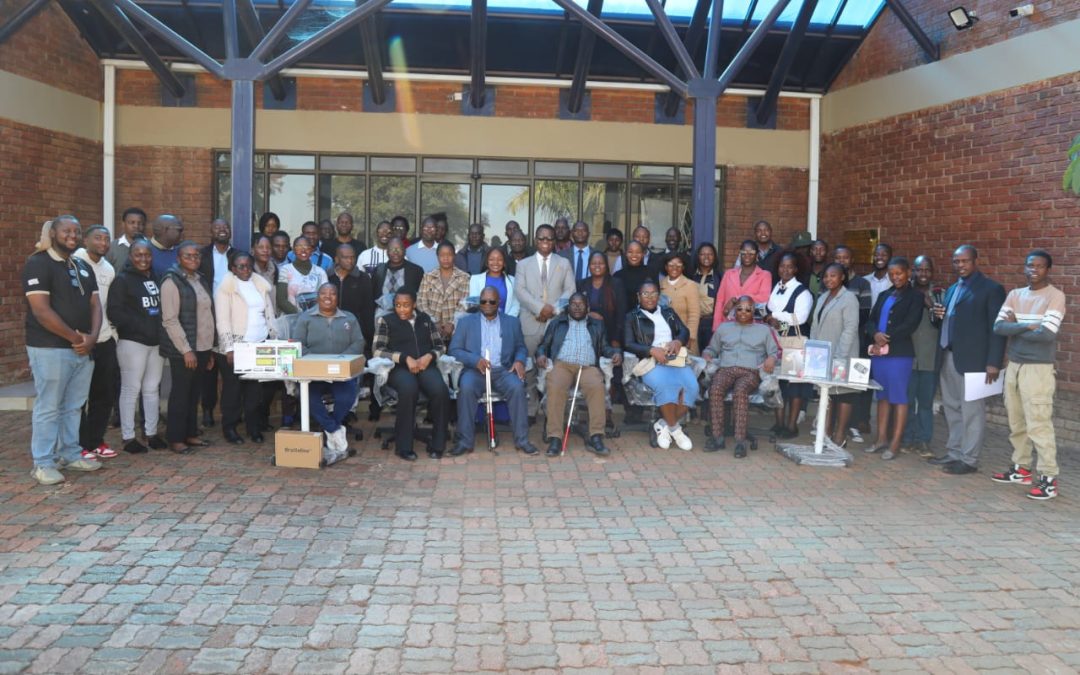
The Gwanda State University Library continues to strengthen its commitment to inclusive and accessible library services following the participation of two (2) library staff members – in a two (2) day Zimbabwe University Libraries Consortium (ZULC) Assistive Devices Training Workshop held at the Harare Institute of Technology (HIT), Harare, from 29-30 June 2026.
The workshop brought together library professionals from ZULC member institutions to enhance their knowledge and practical skills in using assistive technologies that support equitable access to information for persons with disabilities. During the first day, participants were introduced to the different categories of disabilities, with particular emphasis on visual impairment and the role of assistive technologies in promoting independent access to information. Facilitators highlighted the importance of universal design and reasonable accommodation in creating inclusive learning environments that enable all users to benefit from library services.
The workshop also explored strategies for improving access to assistive technologies across Zimbabwean universities. Participants discussed the potential for a consortium-based acquisition of assistive devices through ZULC as a cost-effective approach to maximise available government support and expand access to specialised technologies.
Practical sessions provided participants with hands-on experience using a range of assistive devices, including the Braille One Reader, Keys-U-See Keyboard, C-Pen Reader and Talkback Calculator. These sessions equipped attendees with practical skills for supporting library users with visual impairments.
On the second day, participants received practical training on the Hark Reader and the Victor Reader Stream 3, innovative technologies that enable printed materials to be converted into accessible digital formats. The training also highlighted the significance of the Marrakesh Treaty in facilitating access to published works for persons who are blind, visually impaired, or otherwise print-disabled by permitting the production of accessible format copies without unnecessary copyright barriers.
The workshop concluded with a Mobility Orientation session, where participants engaged in practical demonstrations and simulations that provided valuable insights into appropriate ways of assisting persons with disabilities. The session reinforced best practices for offering support while promoting dignity, independence, and inclusion.
The knowledge and skills acquired during the workshop will contribute significantly to Gwanda State University Library’s ongoing efforts to provide accessible, user-centred services that meet the diverse needs of the university community.